

The bliq team
The assistant that texts you first
An assistant that waits to be opened can only help with things you already remembered. That rules out almost everything that actually goes wrong.
Every assistant built so far optimises the workday. The mess that piles up after it is the harder problem, and nobody was working on it.
The bliq team
bliq

There is a good reason every AI product you have used feels like it was built for an office. That is where the money is. Summarise the meeting, draft the email, refactor the function, fill the spreadsheet. All real problems, all worth solving, all solved reasonably well by now.
And then you close the laptop, and the actual difficulty of your week is still sitting there untouched.
Your sister's housewarming is next Saturday and you have not bought anything. The dentist wants you to call back. There is a flight you should check on. Rent goes out Friday and you are not sure the account has it. Ana has called twice and you keep meaning to call her back at a decent hour and the decent hour keeps passing.
None of that is hard. That is exactly what makes it heavy. Every one of those is two minutes of work and a week of remembering, and the remembering is the expensive part.
The work is not hard. Carrying it around is.
Work AI never touched any of this, because none of it looks like a task in a system. It lives in your head, it arrives at bad times, and it is made of things you told someone once, months ago, in passing.
The tools that exist expect you to arrive at them. You open a tab, you explain your situation from scratch, you get advice, you close the tab, and nothing has actually happened in the world.
That model has three problems, and they compound:
Fix one and the other two still sink you. An assistant that remembers but never speaks is a filing cabinet. One that speaks but cannot act is a nag.
bliq is a thread. One continuous conversation on your phone, the same way you talk to anyone else you know. You do not open a session with it; it is simply there, and it has been there the whole time.
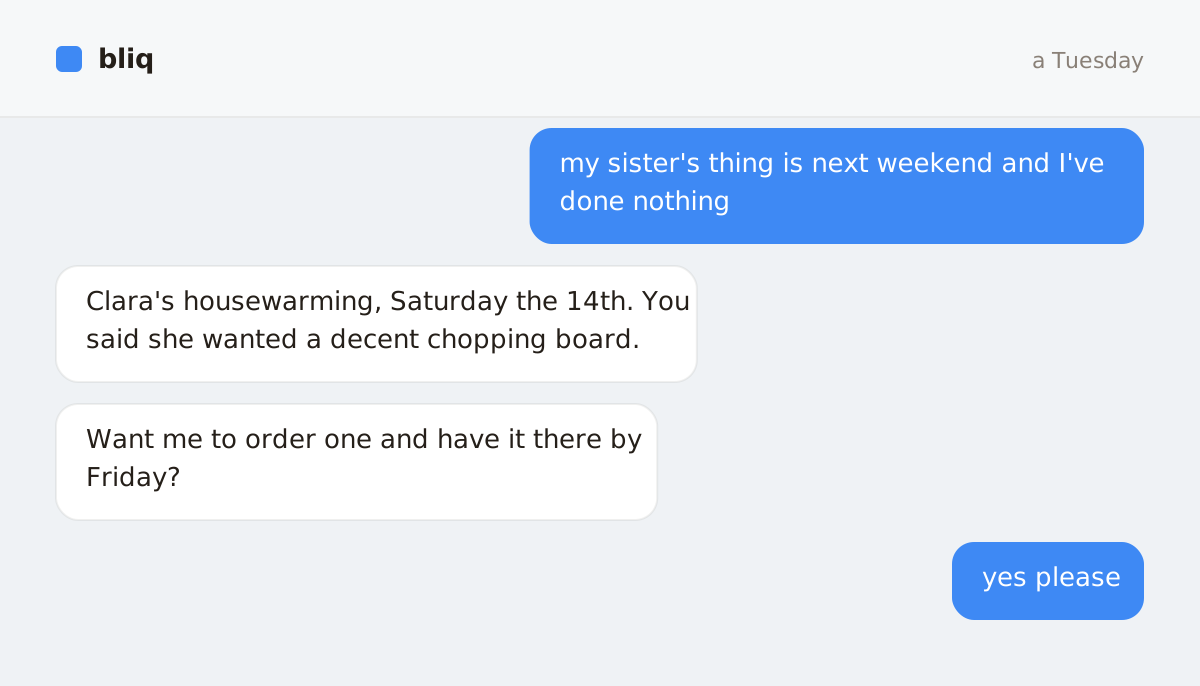
Three things follow from that, and they are the whole product:
Each of those has a post of its own, because each of them turned out to be harder and more interesting than it sounds.
An assistant that is genuinely useful for your life has to know things about your life. There is no version of this where it helps with your sister's birthday without knowing you have a sister.
We would rather say that plainly than dress it up. So the rules are short: you can see everything it knows, you can delete any of it, it is never sold, and it is never used to train anyone else's model. We wrote that out properly in our privacy policy, in language you can actually read.
bliq is on iPhone. Android is next — we would rather one thing feel right than two things feel almost right.
If your job is going fine and your life is the part that is quietly fraying, that is the thing we are building for.
Let bliq handle the rest.
It knows you, checks in on you, and quietly gets the small things done. On iPhone today.
Keep reading